
Search This Supplers Products:Screw Pile / Ground Screw / Helix PileSteel PipeSolar Bracket MountingFoldable Container HouseSteel FenceSeismic Support
Why co-located PV-plus-storage is the best dispatchable renewable energy source?
time2026/06/03
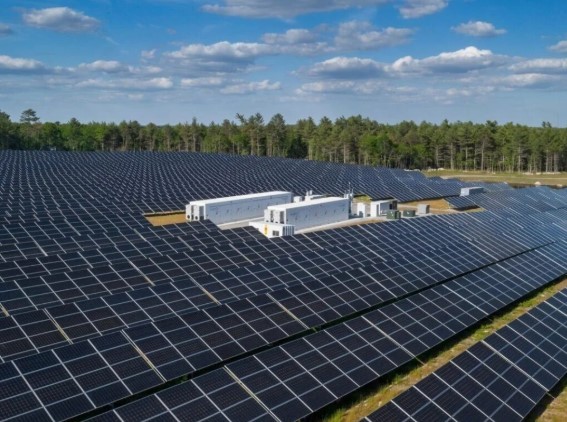
- By Roger Hollies, CTO, Arenko
June 3, 2026
The word “intermittent” is often used—lazily—to write off renewables. The sun shines when it shines, the wind blows when it blows, and power is only available when nature allows it. The idea of intermittency brings connotations of fundamental unpredictability, and stop-start generation with little or no sensitivity to price or need, exposing the technology to price cannibalisation and revenue risk.
This framing no longer reflects how renewable generation behaves in modern power systems. It’s far better to think of renewables as variable instead. Yes, their output changes, sometimes significantly, but it is predictable enough to plan around. This distinction matters as variability can be forecast, managed and optimised in a way that true intermittency cannot.
Add battery energy storage systems (BESS) into the mix, co-located with wind or solar, and the picture changes again. Energy is no longer simply generated and exposed to the market in real time; it can be stored and released when it is most valuable. This makes weather driven generation genuinely dispatchable. Operators gain control over when the energy is delivered, enabling them to determine the price point at which it is exposed to the market, and in doing so, manage the volatility of renewable energy generation.
This is, of course, no secret to the utilities, independent power oroducers (IPPs) and generators racing to balance their generation portfolios with both standalone BESS and hybrid projects. However, not all hybrid projects are created equal. Solar-plus-storage is emerging as the co-location model of choice, for a number of good reasons.
Why solar co-location has the edge
Solar edges out wind for co-location dispatchability on two counts. First, it’s more predictable over intraseasonal and intraday timescales; second, it aligns more naturally with current mainstream battery durations, allowing energy to be moved within and across day timeframes, capturing spreads in intraday and day-ahead markets.
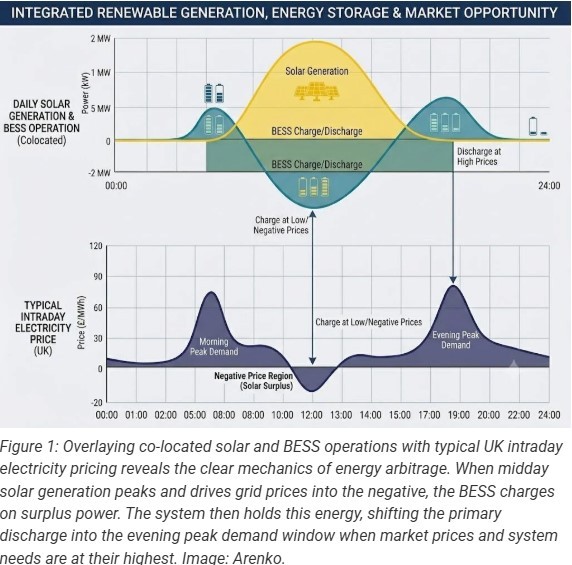
The synergy between the two technologies has long been discussed and the benefits to owners and operators are now increasingly visible in operational assets. It’s simple and elegant: solar generation peaks at midday, when wholesale prices are often lowest due to low demand/oversupply. Batteries, meanwhile, can charge during these low-price periods and discharge into higher-value morning and evening peaks.
This is why the combination is increasingly attractive commercially. Through BESS, the grid connection can be used more flexibly, with solar’s predictable daily profile aligning closely with battery charge and discharge cycles, enabling more of the asset’s output to be shifted into higher-value periods and improving both revenue capture and utilisation of the grid connection.
The technologies are therefore highly complementary: solar produces when energy is abundant, leaving room for regular storage export that shifts energy into periods where the system needs it most. The result is the core tenet of any sustainable energy future system – highly dispatchable renewable energy.
Unlocking value from a growing capacity base
In the UK, the combination looks set to be rolled out at pace. Despite the country’s reputation for grey skies, installed solar capacity has reached 22.1GW as of March this year, according to data from the Department of Energy Security and Net Zero. It’s forecast to continue growing strongly, with analysts expecting 5–5.5GW of new solar capacity in 2026 alone.
As more solar connects to the system, generation concentrates around midday and supply can outrun demand, pushing prices very low or even into the negative.
Standalone batteries are changing the equation by taking the surplus and carrying it into peak periods, converting low-value solar output into dispatchable capacity aligned with system need.
Co-location takes these benefits even further. By combining solar and battery storage behind a single grid connection, developers can reduce infrastructure costs while maximising the performance of both technologies.
The opportunity is not limited to new developments either; batteries can also be retrofitted onto existing solar sites. Even where import capacity is constrained, ‘green’ BESS projects (where batteries charge exclusively from on-site solar generation) can unlock significant value. While grid reform still needs to catch up to fully support this approach, it’s a highly attractive opportunity that is now being reflected in the plans of UK and European portfolio owners.
These dynamics are a key reason why solar-plus-storage is emerging as a critical component of the future energy system. Both technologies are modular, scalable and fast to deploy, while also supporting a more distributed and resilient grid.
Complexity increases—and so does the need for automation
Standalone solar assets are relatively simple to operate as they are effectively plug and play systems. They generate what they generate, maintenance requirements are relatively low, and performance is largely measured by total yield.
Introduce storage, and the asset becomes significantly more complex. Operators must now decide when to charge, when to discharge, who gets priority over the grid connection, how to respond to market signals and how to balance competing revenue streams.
Moving from standalone solar to a co-located system represents a step change in operational complexity and demands a new layer of data infrastructure and decision-making to maximise value. Platforms such as Nimbus exist precisely to manage this complexity, automating the process of coordinating dispatch decisions across both solar and storage in real time. Without that optimisation layer—a ‘digital backbone’ capable of handling significant volumes of technical and commercial data—it will be highly challenging for trading teams to fully realise the value of co-located assets.
With it, co-located solar-plus-storage projects can deliver exceptional revenue performance, as we discussed in the first blog of this series.
Why AC vs DC matters
The shift towards truly dispatchable renewable energy also changes how co-located assets are designed and operated. In standalone solar, the focus is purely on maximising generation; once storage is added and energy dispatch is being timed into higher-price periods, overall system efficiency becomes more important.
This is fuelling interest in DC-coupled solar-plus-storage systems. While AC-coupled configurations are the most established and widely deployed approach, DC coupling can reduce conversion losses between solar generation, storage and export, improving efficiency and increasing the energy available for dispatch during peak periods.
The trade-off is greater operational complexity, particularly around integration and metering, but as the market prioritises firm power, these efficiency gains are hard to ignore.
A key contributor to European energy security
Deployed at scale, co-located solar and storage has the potential to shake off the intermittency badge that has hindered renewables growth – offering a clean, low-cost and reliable source of energy that can be dispatched to match demand and support system security. Even during winter periods, when solar output is lower, batteries continue to add value by responding dynamically to real-time price movements—charging during low-price periods and discharging during demand spikes. They can also respond to wider system shocks, including geopolitical events that drive sudden volatility in energy markets.
There are very few scenarios in which adding storage does not improve solar asset performance. The UK is increasingly demonstrating how co-located solar plus storage can be dispatched in practice and Europe is beginning to draw lessons from how these assets are being operated at scale.
In future pieces we’ll dive deeper into how commercial, technical and market complexity can be managed to support the rollout and operation of these vital projects.