
Search This Supplers Products:Screw Pile / Ground Screw / Helix PileSteel PipeSolar Bracket MountingFoldable Container HouseSteel FenceSeismic Support
Philippines imported 4 GW of Chinese solar panels in January-April
publisherJFN
time2026/06/08
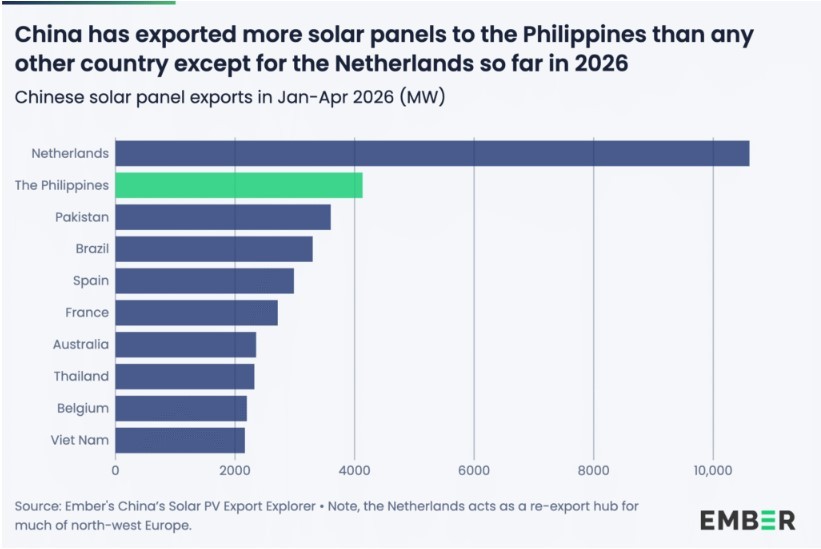
- Over 4 GW of Chinese solar panels were imported into the Philippines between January and April this year.
Over 4 GW of Chinese solar panels were imported into the Philippines between January and April this year, according to the latest report from energy think tank Ember.
Ember’s latest report uses Philippines customs data to highlight a growing surge in solar panel imports into the country.
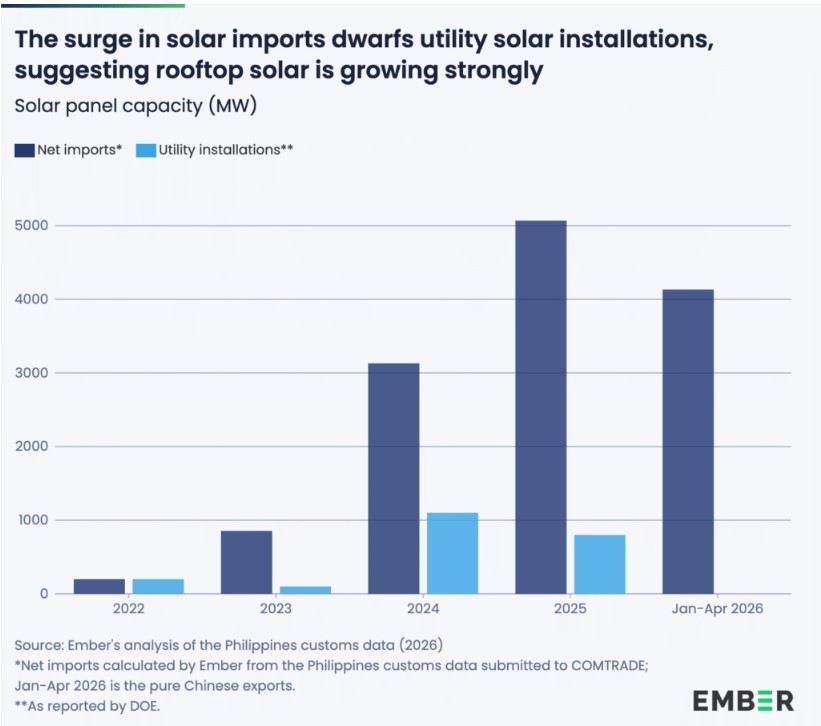
Net solar imports stood at 3,130 MW in 2024, increasing to 5,068 MW in 2025 and reaching 4,133 MW over the first four months of this year, according to Ember’s figures. China has exported more solar panels to the Philippines this year than any other country except for the Netherlands, which acts as an import hub for much of Northwest Europe.
Ember’s report says the surge in solar panel imports suggests that rooftop solar deployment will begin to accelerate. The think tank analyzed generation data from electricity market operator IEMOP to calculate current rooftop capacity at around 1.3 GW, up from 721 MW towards the start of 2025.
“In 2025, the Philippines imported more than five times as much solar panel capacity as the grid-connected utility-scale solar it had installed. This implies a large inventory buildup that will translate into future installations,” the report explains. “The large step-up in Chinese solar panel exports shows that an even bigger gap is emerging.”
The report also found that rooftop solar’s payback time in the Philippines has crashed as electricity prices in the country soar.
Retail prices from electric power distribution company Meralco were 17% higher for retail customers, 18% higher for commercial customers and 14% higher for industrial customers in May 2026 than they were in May 2025. These increases make the Philippines home to the most expensive residential electricity price in Southeast Asia, as well as the second-highest commercial price and the third-highest industrial price.
Ember says this upward trajectory has helped reduce the payback time for residential rooftop solar from 4 years in May 2025 to 3.1 years in 2026. Over the same time period, the payback time for commercial rooftop solar fell from 3 years to 2.3 years and from 3.9 years to 3.1 years for industrial rooftop solar.
The report suggests that these payback times should encourage mass uptake of rooftop solar, particularly when combined with policy changes designed to incentivize adoption, such as the easing of approval processes governing the country’s net metering scheme.
Dave Jones, Chief Analyst at Ember and lead author of the report, said the rapid rise of rooftop solar in the Philippines is “inevitable”.
“The government has an opportunity to carve its own path on rooftop solar, to pull the Philippines out of fossil dependency and onto a path of cheap, abundant electricity,” he said.
The report sets a target of deploying 3.5 GW of rooftop solar paired with 4.5 GWh of battery storage – matching the capacity under development in the country’s massive MTerra Solar project – within 24 months. It recommends several policy interventions required to unlock such scale, including expanding solar loan schemes, enabling smaller plug-and-play solar and introducing a government project to build batteries.
Ember’s report also highlights the emergence of domestic solar manufacturing in the Philippines.
Chinese trade data shows that $292 million of solar cells were exported to the Philippines between October 2025 and March 2026, up from almost nothing previously, equivalent to over 6.6 GW of capacity.
Large manufacturing facilities are beginning operations in the Philippines Economic Zone Authority, including a 1 GW manufacturing plant that opened in May 2025 and a second 1 GW plant that opened last month, both belonging to Singapore-based solar manufacturer Gstar.
The Philippines added 899 MW of solar last year, according to figures from the International Renewable Energy Agency (IRENA), taking cumulative capacity to over 3.8 GW.