
Search This Supplers Products:Screw Pile / Ground Screw / Helix PileSteel PipeSolar Bracket MountingFoldable Container HouseSteel FenceSeismic Support
Chinese scientists unveil cable-supported mounting system for large-scale PV on complex terrain
publisherJFN
time2026/06/22
- Researchers from Chongqing University and PowerChina developed a two-parallel cable-truss CSPS to improve torsional resistance and wind stability for PV plants on complex terrain. Validated through a 40 m-span numerical study, the design enhances flutter resistance and structural stiffness while optimizing sag and pretension for efficient large-scale deployment.
Researchers from China’s Chongqing University and industrial conglomerate PowerChina have developed a cable-supported photovoltaic structure (CSPS) designed for deployment in solar projects planned on complex and challenging terrain. The system is intended to overcome the limitations of conventional ground-mounted PV structures, particularly in regions where uneven topography, large spans, and difficult construction conditions make traditional support systems inefficient or impractical.
“Mainstream CSPSs in PV plants include single-layer cable systems, space cable systems, and cable-truss systems,” corresponding author Shidong Nie told pv magazine. “Single-layer systems are simple suffer large wind-induced displacements and are unsuitable for large span, while space cable systems add lower cables to improve vertical stiffness and reduce wind-driven deformation. Cable-truss systems further add wind-uplift cables, improving resistance to both downward and upward wind loads.
However, all these systems still have weak torsional resistance, leading to instability, tilt, and low flutter wind-speed limits.”
With these limitations in mind, the research team developed new two-parallel cable truss-supported PV structure. “We developed a mechanical model, along with derived methods for both single cables and cable trusses,” Nie added. “These methods are combined into an iterative design strategy and a simple sag-determination formula for engineering use. A 40 m span case study was used to validate the model and sag formula through numerical simulations. Finally, static response and parametric effects of cable tension and sag on deflection control are analyzed to guide design decisions.”
In the paper “A novel cable-supported photovoltaic structure with high torsional resistance and its optimal parameters,” published in Results in Engineering, the researchers explained that the system is inspired by bridge aerodynamics, where increasing torsional stiffness helps suppress flutter and raise critical wind speeds.
They split a single cable truss into two parallel trusses, which they claim improves the torsional load-resisting mechanism without increasing total material use.
The system also supports two rows of PV modules connected via π-shaped purlins, which enlarge the lever arm and further enhance torsional stiffness. This configuration reportedly improves torsional mode frequency and increases the critical flutter wind speed, estimated at 36.8 m/s for a 40 m span, while minor added components like purlins and braces slightly increase steel use but improve stiffness and vibration control. In addition, braces placed at regular intervals help maintain an accurate parabolic cable shape consistent with theoretical models.
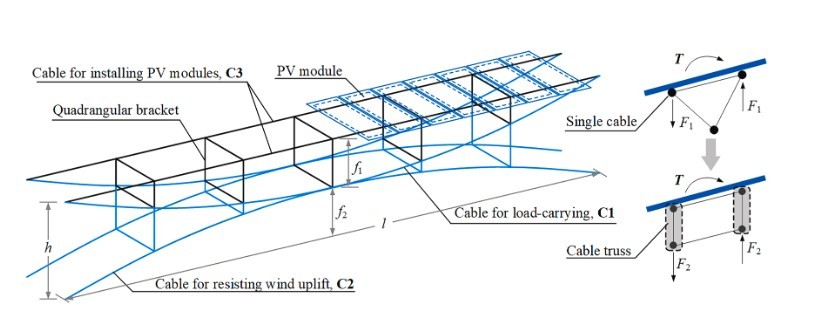
In addition, key design parameters include cable sags, truss height, and cable pretensions, all of which strongly influence structural behavior. Different sags are required to balance gravity, wind pressure, and wind uplift effects according to design codes. Proper selection and iteration of geometry and pretension are essential to achieve optimal stiffness and deformation control, the scientists said.
In the proposed system configuration, the cable truss was treated as the primary load-bearing system, with PV module loads transferred to it as equivalent uniformly distributed forces. The structural design is defined by key parameters, including the total truss height, the individual sags of each cable, and the pretension levels in different cable groups.
“To determine these values, a unified iterative framework was developed to adjust sag and achieve balanced resistance to gravity, wind pressure, and wind uplift,” Nie explained. “Once the geometric configuration was established, cable pretensions were evaluated through dynamic analysis based on the structure’s natural frequencies. These dynamic properties were then linked to the flutter critical wind speed. Finally, the optimal pretension combination was selected by maximizing or locally maximizing the critical flutter wind speed response.”
The proposed design was validated through a detailed numerical study of a 40 m-span CSPS, developed in accordance with Chinese structural design codes under extreme wind conditions representative of hurricane-level events. A design wind pressure of approximately 0.654 kPa, combined with a gust factor of 1.7, was used alongside a 20° module tilt and standard wind shape coefficients to establish realistic loading scenarios.
Using the iterative design method, the initial sag values of the cable truss were determined as 2,230 mm and 1,770 mm. These values were derived assuming a 30 kN pretension in the load-carrying cable and were shown to be stable across a wide range of pretension conditions. Parametric analysis confirmed that once wind pressure exceeds 0.45 kPa, the calculated sag becomes largely insensitive to pretension variations, reinforcing the robustness of the proposed geometric design approach.
After applying pretension and dead loads, modal analysis was carried out to extract the structure’s dynamic characteristics. The results showed that increasing cable pretension generally increases both vertical and torsional natural frequencies, although their ratio does not evolve monotonically.
Flutter assessment revealed a clear peak in critical wind speed at an optimal pretension combination, with 30 kN identified as the most efficient value for the primary load-carrying cable. Importantly, further increases in pretension did not consistently improve aerodynamic stability, highlighting the need for balanced design rather than simple force maximization.
Static and parametric analyses further demonstrated that geometric configuration plays a dominant role in structural performance. In particular, increasing the truss height proved significantly more effective in reducing both vertical and torsional deformations than adjusting cable pretension. These results confirm that geometric optimization is the key driver of stiffness and stability in large-span CSPS designs.
“Overall, the study validates the proposed two-parallel cable truss system as a structurally efficient and aerodynamically robust solution for PV deployment in high-wind and complex terrain environments, offering a practical design framework for future large-scale solar infrastructure,” Nie concluded.