
Search This Supplers Products:Screw Pile / Ground Screw / Helix PileSteel PipeSolar Bracket MountingFoldable Container HouseSteel FenceSeismic Support
Solar everywhere: The infrastructure opportunity
publisherJFN
time2026/06/26
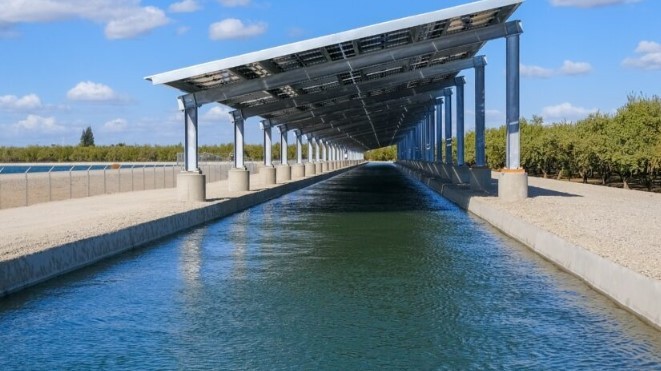
- As Europe’s most attractive rooftops and most favourable sites fill up with solar, a new logic is taking hold: the dual use of land. After agrivoltaics, floating PV and building-integrated solar, it is now the turn of infrastructure such as roads, railways, canals and dikes to become a solar resource.
Solar PV is one of the pillars of Europe’s energy transition. With more than 65 GW of new capacity installed in 2025 and more than 405 GW already operating, the European Union is pressing on toward its target of 750 GW of solar PV by 2030. Reaching that target will require installing a further 345 GW or so over the next five years. The geography of solar PV capacity additions is changing. The large, well-oriented rooftops, the easily connected sites and the most favourable locations are gradually being used up. At the same time, ground-mounted solar projects in some countries face concerns over competing land uses, the protection of farmland, biodiversity and local acceptance.
We recently argued in these pages that lightweight modules could unlock more than 85 GW of structurally constrained European rooftops. The pressure behind that argument is the same one, pushing developers to look beyond the most straightforward sites. The question is no longer whether Europe wants more solar; it is where, exactly, the next gigawatts will physically go, and how the electricity they generate will be integrated into the grid and turned to value.
Dual-use solar: the logic of ‘PV everywhere’
Some of the most promising new segments share a single idea, gathered under the banner of ‘PV everywhere’: rather than searching for new land, share the surfaces we already use. Agrivoltaics keeps farmland in production while generating energy. Floating PV, building- and vehicle-integrated PV turn reservoirs, facades, cars, and more into electricity production assets. In every case the breakthrough is the same: solar no longer competes for space but shares it.
Another category of space, less often discussed, fits this same logic: the land that runs alongside our transport and water infrastructure. Motorway verges and embankments, railway tracks and cuttings, noise barriers, the faces of flood dikes, canal banks, cycle paths and technical rights-of-way border almost every road and rail line on the continent. The sector is still settling on a name: infrastructure-integrated PV (IIPV) in the research literature, ‘linear PV’ for its geometry, or more plainly solar highways, solar railways and canal-top solar in the press. The logic, however, is familiar. This land is already developed, already controlled by a public body or a concession holder, and already serving a primary function. Adding generation on top of it while preserving natural and rewilded corridors, tends to raise far fewer acceptance objections. Not a new kind of terrain, but a new relationship with the terrain we have already built on.
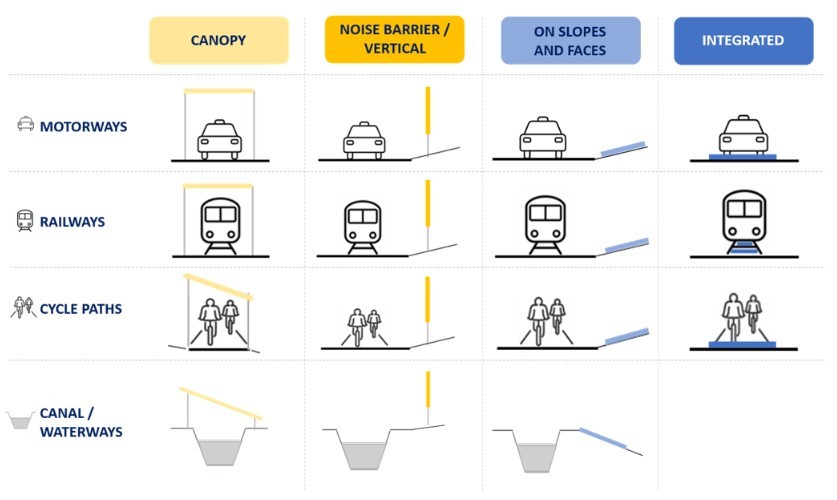
Sizing the European prize
The potential is anything but marginal. In a pan-European assessment, the European Commission’s Joint Research Centre estimates that applied PV across rooftops, reservoirs and road and rail infrastructure could exceed 1 TW of installed capacity, well beyond the EU’s 2030 target. The linear-infrastructure share is particularly striking: this study puts the gross potential for vertical PV along the EU’s roads and railways at 403 GW, roughly 50% of the 2030 goal. Analysis also finds that deploying vertical, east-west bifacial PV at scale would raise the market value of solar generation and dampen the midday price cannibalisation that increasingly erodes the revenue of conventional south-facing arrays. While these are technical potentials rather than market forecasts, even a fraction of the potential would be significant.
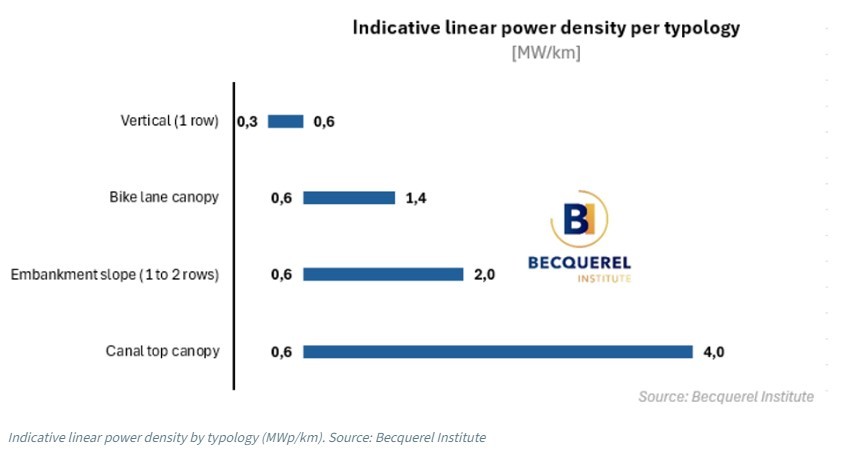
Taking a realistic linear power density of between roughly 0.3 MW per kilometre for a single row of vertical bifacial modules and more than 2 MW per kilometre for wider systems, the orders of magnitude add up quickly once applied to tens of thousands of kilometres of infrastructure corridors.
The opportunity, moreover, extends beyond land. Many of these infrastructure assets (motorways, railways, canals) already consume electricity or sit adjacent to existing grid connections. That proximity turns a land-use argument into an energy-system argument: generation sited on infrastructure can feed directly into a local load or an existing connection point, reducing curtailment risk and easing the grid-integration challenge that constrains so many conventional solar projects.
What the world is already building
China has moved fastest and at by far the largest scale, developing a transport-linked PV market with no equivalent elsewhere. Highway-linked solar reached about 1.7 GW by the end of 2024, and the China Academy of Transportation Sciences estimates the roadside potential at close to 944 GW. Multiple provinces are now developing near-zero-carbon highway service areas. The flagship Jinan–Weifang corridor for example carries 68 MW generating some 68 GWh a year according to its operator.
Asia offers other demonstrators of several kinds. South Korea’s Daejeon–Sejong cycle path canopy runs down a motorway’s central corridor since the mid-2010s; with some 7,500 panels over 4.8 km as shared by the Ministry of Infrastructure and Transport of South Korea.
India pioneered canal-top solar in Gujarat over a decade ago: the Narmada Canal Public Authority reports scaling from a 1 MW pilot in 2012 to roughly around 35 MW today, while cutting evaporation. In Japan, interest in transport-integrated PV is accelerating. The Ministry of Land, Infrastructure, Transport and Tourism (MLIT) has launched a national programme to evaluate road-surface solar technologies, while motorway operators are exploring the use of embankments, sound barriers and service-area land for photovoltaic generation.
In the United States of America, The Ray, a demonstration corridor along Interstate 85 in Georgia hosts a 1 MW roadside array, while a University of Texas at Austin analysis suggests interchange land alone, representing some 21,000 ha, could theoretically generate up to 36 TWh a year. On the water side, the Gila River Indian Community in Arizona switched on what it describes as the Western Hemisphere’s first operational solar-over-canal project around 1.3 MW in 2024, with California’s state-backed Project Nexus close behind.
European examples are multiplying too. Noise barriers are the most mature pathway. Published surveys put the larger German motorway installations at 1 to 2 MWp apiece, the Dutch roads authority runs a bifacial ‘solar highway’ pilot on the A50, and Austria’s and Switzerland’s motorway and rail operators are increasingly opening their noise barriers to PV at scale. Beyond barriers, the variety of surfaces is striking: removable modules between the rails on a Swiss line near Buttes, vertical bifacial arrays on the Rhône’s dikes, roughly 900 m of canopies over a French cycle route, and even a solar jetty at a Mediterranean marina.
The geometry of the challenge
None of this is easy. The defining challenge of linear PV is co-usage: the panels must never compromise the primary function of the infrastructure, whether the stability of a dike, the emergency access of a motorway, the maintenance access to a railway or the navigability of a waterway. Each typology carries its own constraints, whether glare studies, emergency access, hydraulic transparency or mechanical loads.
Spreading electricity generation over kilometres also multiplies connection points or step-up transformers, cabling runs and losses, and pushes developers toward new architectures. A French research project is exploring medium-voltage direct current to carry power efficiently along a cycle path, while in Switzerland work on a ‘railway smart grid’ treats the corridor as a genuine microgrid, combining trackside solar, traction supply, recovered braking energy and EV charging.
Because a single project can cross many jurisdictions, fragmented permitting can be an obstacle; add the variety of land tenures, from public domain to concession holders and private owners, and the business models become markedly more complex than for a conventional plant.
Making the business case
Like any solar plant, an infrastructure-integrated system can sell its electricity (under a state-supported offtake mechanism such as a contract for difference or feed-in tariff, or at wholesale market prices), consume it on or near the site, or combine both routes. The business case can nonetheless be more demanding than for ground-mounted solar: upfront costs can be higher, reflecting a more complex linear electrical architecture, elevated mounting and specific module coatings, while operating costs too can be elevated by soiling, restricted access and exposure, even where land is cheap or free. In practice, self-consumption by nearby off-takers and contract for difference obtained in dedicated calls for tenders appear to be the most reliable routes to project viability.
From pilots to scale
The way forward is not to treat linear PV as a single product, but as a portfolio of typologies at different stages of maturity contributing to one pathway among several toward the 2030 target, complementing rooftops, agrivoltaics and floating PV. The pragmatic path starts with the least-constrained, most easily replicable configurations. A critical parallel task is to continue building the evidence base that operators need: structured monitoring of early deployments to show both that PV system and generation does not interfere with the primary infrastructure function and that the infrastructure’s operation, maintenance and vibrations do not degrade PV performance.
Three levers would accelerate the move from demonstrators to deployment. (1) Large-scale demonstration projects are needed to build the evidence base. (2) Projects need clear permitting doctrines and coordinated approvals. (3) And these sites should be explicitly included in public tenders, whether through a dedicated envelope for infrastructure-sited projects or a price premium that offsets their higher development cost, at least for now.
Europe’s solar story is far from over, but it is entering a more demanding chapter. The next gigawatts will increasingly come from sites that are more constrained and more inventive. Dual use answers the constraint of surface availability, and linear PV alone puts hundreds of gigawatts of technically accessible potential along the continent’s roads, railways and canals. The land has been there all along. The opportunity now lies in learning to share it.