
Search This Supplers Products:Screw Pile / Ground Screw / Helix PileSteel PipeSolar Bracket MountingFoldable Container HouseSteel FenceSeismic Support
Solar boom in the Philippines continues as electricity prices rise
publisherJFN
time2026/07/08

- Solar panel imports to the Philippines are continuing to grow as residential electricity tariffs rise to the highest in southeast Asia, with an estimated 3 GW of imported Chinese panels currently destined for the country.
Solar panel imports to the Philippines are continuing to increase as electricity prices in the country soar and panel costs fall.
Alnie Demoral, energy analyst at Ember specializing in Asian markets, told pv magazine that Chinese solar panel exports in March and April 2026 reached record levels, suggesting that over 3 GW of additional panels may be destined for the Philippines.
The finding builds on research from Ember published in May which found over 4 GW of Chinese solar panels were imported into the Philippines between January and April this year. The figure places the Philippines second for Chinese solar panel imports globally, behind only the Netherlands which acts as an import hub for much of Northwest Europe.
Analysis by Ember of the United Nations’ Comtrade database found net solar panel imports into the Philippines increased from $365 million in 2024 to $483 million in 2025. Demoral explained that global panel prices means this translates into a 62% increase in imported solar capacity, from 3.1 GW to 5.1 GW.
“China supplied 98% of these imports, while around 14% (by value) were re-exported, with the United States emerging as a key destination from September 2025,” Demoral said.
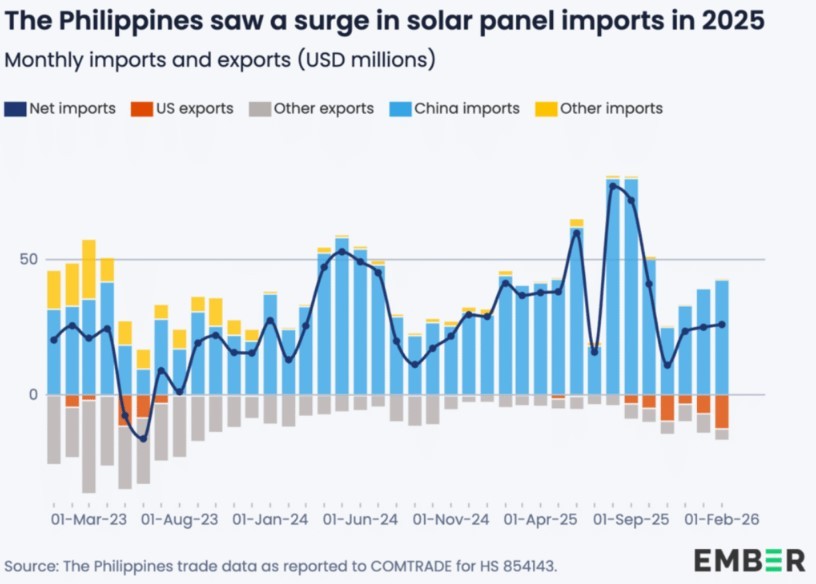
Demoral attributes the growing interest in solar across the Philippines to a dramatic fall in solar panel costs, caused by improvements in manufacturing and global oversupply, as well as rising electricity prices. She explained these higher prices are caused by the power system in the Philippines remaining heavily reliant on imported fossil fuels, leaving customers vulnerable to global fuel price spikes.
According to reports from Reuters, power distributor Meralco has raised prices by 10% since the Middle East conflict began in late February. In March, President Ferdinand Marcos Jr. called the conflict an “imminent danger” to the country’s energy supply, enacting a state of energy emergency expected to last initially for a year.
The Philippines imports almost all the coal and liquified natural gas that currently makes up around three quarters of its power generation. Residential electricity tariffs are currently the highest in Southeast Asia and among the highest in the world.
“For many Filipino families, electricity already takes up a significant share of the household budget,” Demoral told pv magazine, before adding that the growing interest in solar is visible across both residential and commercial markets.
“Businesses moved first because they have high daytime electricity use and can recover their investment very quickly. But today, we’re also seeing strong growth among homeowners because rooftop solar has become much more affordable, especially with the emergence of leasing models and low-interest loans that allow the upfront cost to be paid in instalments,” Demoral explained.
“Today, many homeowners can recover their investment in around three years, while some businesses can do so in as little as two years.”
Last month, the Department of Trade and Industry of the Philippines began the process of placing solar equipment, including PV panels and batteries, under its mandatory product certification program to ensure products sold in the country are reliable, safe and of a high technical standard.